
Alison Uttley wrote Little Grey Rabbit’s Washing Day during WWII, her son who was inspired by their laundry drying on the line suggested the plot. According to Country Child, Uttley preferred it to Water Rat’s Picnic and chuckled as she wrote it.
Warning
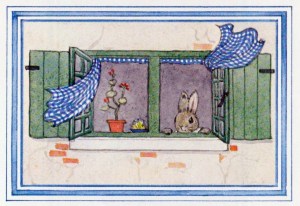
Like the Warner Brother’s Warning: The books are a product of their times, there have been a handful of moments in other LGR books that make me pause and side-eye the text, but G*psy Rabbit takes the cake. G*psy is an ethnic slur. I can understand it appearing in earlier editions, but I’m sad to see it appears in the post 1990’s recent reprints and the cartoon. Even if they were to change to Roma Rabbit, the character itself perpetuates the magical free spirit and loose with the truth stereotype imposed on the Roma people. I don’t mean to sound righteous –I didn’t learn that G*psy is an ethnic slur until adulthood, but hearing it tossed around in some of my favorite old books and television programs (Madeline, Little Grey Rabbit goes to the Sea, I Love Lucy, Where the Sidewalk Ends and there’s probably more.) makes me wince, so I can only be empathetic and imagine how it would feel to someone of Roma descent, especially a child.
Summary
A breezy spring day sets up the laundry angle. When a peddler comes along and sells Rabbit some pegs, she decides to have a big wash day. They take in laundry from all their friends and take advantage of the sunny, breezy day. Mix-ups ensue in returning everyone’s belongings. There’s magic in the clothes pegs that ring alarms and fools would be predators. The English nursery rhyme I Had a Little Nut Tree is worked into the story.
Abridged
They shaved to it down from 88 pages to 46. A reference to the son of the weasel who “was killed” in The Squirrel, the Hare, and the Little Grey Rabbit, and a scene where Fuzzypeg almost getting spanked by his father are omitted from the reprint.
G*psy Rabbit
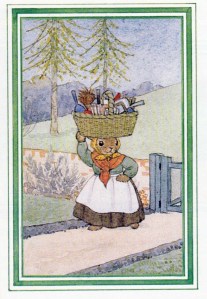 She’s a traveling peddler who sings a lot, and bends the truth a little. For example, she claims to know of a silver-mine, but later reveals its actually tin binding the clothes pegs. She accepts barter when Grey Rabbit has no money, and is supposed to sleep in the bracken brewing magic, dancing in fairy rings. These last details maybe faulty exaggerations of Milkman Hedgehog and Grey Rabbit’s to make G*psy Rabbit seem exotic. Yet, she also disappears quickly, whether if it’s just stealth or supernatural it’s left to the reader to decide. She also peddles exotic goods like nutmeg, as well as everyday items like mirrors, saucepans and brushes. Grey Rabbit is rather firm denying Squirrel these goods by referencing their country ways mentioned in the foreword: “there’s a stream at the bottom of the garden where you can see yourself.”
Wise Hare…
Hare is actually knowledgeable in this book, he knows more about nutmeg than Squirrel or Grey Rabbit. However he’s back to his childish ways when he takes credit for planting a nutmeg tree from Hedgehog. Also, when he bungles the laundry delivery, making everyone have to hunt for his or her belongings. Rather than correct his mistake, he rationalizes this saying their friends ought to be grateful because their laundry was done for free. Grey Rabbit reminds him she did it for love—and how! Laundry pre-washing machine was hard work! Squirrel also reveals a playful childish side in this book, the scene where she is supposed to be hanging the laundry line, but swings on it instead: “The rope hung in such a lovely loop she couldn’t resist swinging on it. Hare pushed her gently backward and forward gently till it broke and she had to tie it again.”
Things you might take for granted…
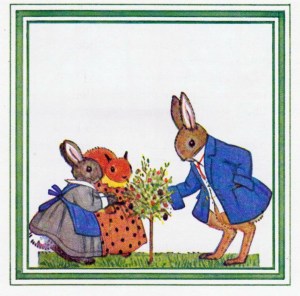 Ground nutmeg in a canister is the only way I’ve ever known it, but I have seen a nutmeg grater similar to the one in the story at a historical site. The site interpreter explained it stays fresher and lasts longer in its whole form since the peddler didn’t pass through backwoods areas frequently. It’s exotic in this story, as it’s not native to England. Consider the nursery rhyme where the little nut tree bears a silver nutmeg that attracts the King of Spain’s daughter. One could suppose the rhyme compares the value of nutmeg to silver. Especially in the 17thcentury it was a luxury spice and used for medicinal purposes.
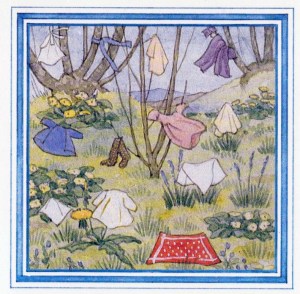 Alison Uttley must’ve been chuckling about the easy quick way the laundry is done. As I’ve said before it was hard work scrubbing, rinsing, and wringing by hand. Not to mention hanging, folding and ironing. Fun fact about laundry day: if you didn’t have clothespins, you’d have to weigh your laundry down with some stones, and there was still the risk of your things being blown away. I’ve heard of laying out laundry to dry over fragrant bushes—like lavender. We find out Mrs. Hedgehog is a champion ironer and is volunteered by her husband to help Grey Rabbit out. They use specialized irons heated on the hearth (flats and crimpers) likely for fancy items like Water-rat’s frills and Squirrel’s ruffled dresses. Lastly, Grey Rabbit once owned some clothes-pegs but the rooks stole them all, hopefully the shiny bands on the new pegs (not to mention the alarm) would discourage the rook from stealing.
Illustrations
Plenty of bright pretty illustrations by Margaret Tempest. I have a feeling she was inspired by 18th century pastorals. The way Grey Rabbit’s skirt is tucked up and G*psy Rabbit’s whole look gives romantic 18th century vibes. I love the red spotted handkerchief that is laid out in the laundry illustration–this may be a stretch, but it could be a nod to Peter Rabbit (which likely would’ve made Alison Uttley furious at Margaret Tempest), or just a typical 18th century style print.
There’s an interesting illustration that I realized is only in the Little Grey Rabbit Library edition. I think it may be a composite created especially for this book. It has an isolated background, and most “found” / “long lost” illustrations (like the ones used in Further Tales of Little Grey Rabbit) by Margaret Tempest have a background and are usually signed.


Final Thoughts
The dark cloud of the ethnic slur and stereotypes aside, it’s a cute and romantic story about a commonplace household chore. Yet, there is something charming and nostalgic about seeing laundry flapping in a breeze. You know how laundry detergent commercials will often make an appeal to nostalgia, where they have bed sheets drying on a line in the sunshine, then all folded up in a wicker basket? It’s a bit like that, written by someone whom I suspect never had to do a routine load of laundry. Or maybe that’s why she chucked so, because she did know the rigors of laundry day.

 Little Grey Rabbit Scholar