
June 6, 2019 was the 75thanniversary of D-Day and so I chose to spotlight Hare Joins the Home Guard. It was published in 1941, and the copy I am using is an abridged Diamond Book reprint from 1994.
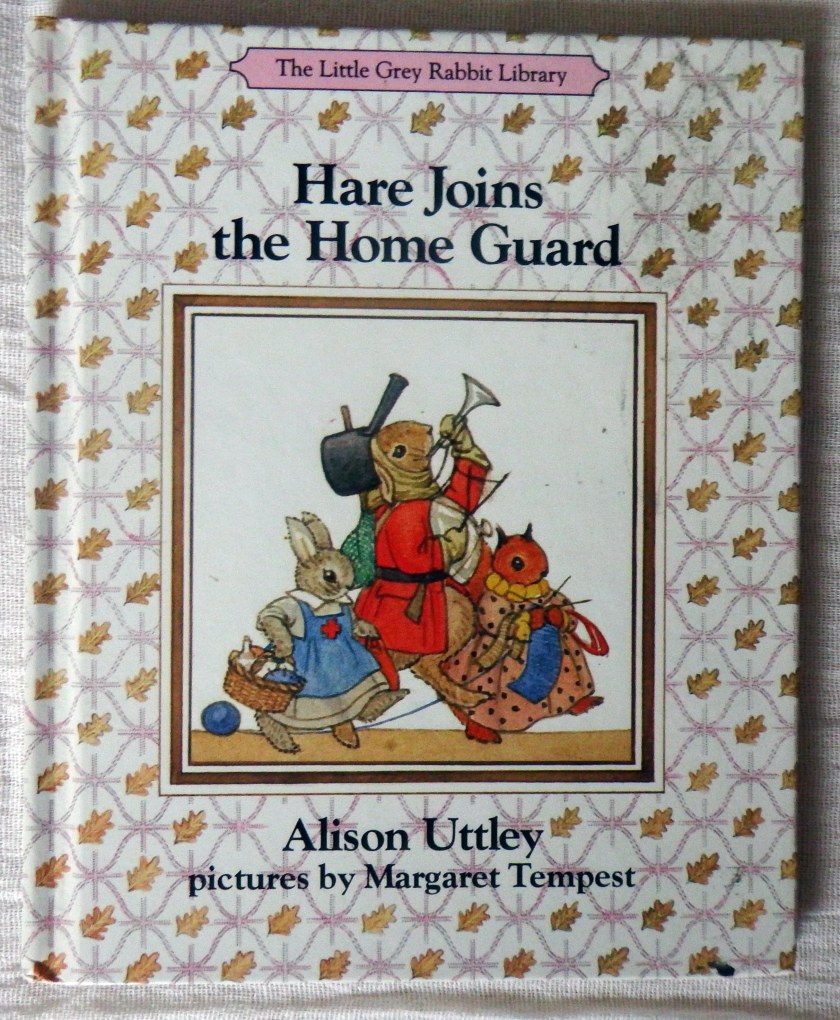
War comes to Little Grey Rabbit’s peaceful land, and everyone must do his or her part to support the war effort. Grey Rabbit is a one woman Red Cross unit, Squirrel knits socks and mittens for the troops and Hare joins the Home Guard.
The enemy invader is an army of Weasels from an unspecified “wild land”. The working title was Grey Rabbit’s War, and was written during World War II, and brings contemporary troubles into the world of LGR. In Alison Uttley: Life of a Country Child, Dennis Judd posits, “…the book must have reassured thousands of young readers aware that Britain faced imminent invasion and defeat.” This really placed the book in context for me. In school, I remember constantly being told how fortunate the United States was not to have major battles take place stateside during WWII. Judd supports his statement by citing a letter Alison Uttley received from a young boy who believed “…Goebbels won’t let the Nazis come now because Hare will stop them.” It’s rather reassuring of the power of books as tools of comfort and distraction, but also ironic seeing as Hare is hardly the hero this kid writing to Alison Uttley thought he was, as we shall see.
The Home Guard? Like the Old Home Guard in Bedknobs and Broomsticks? I love history, but WWII is not my forte, and history classes tended to gloss over and focus on the United State’s part in WWII. According to The Rutledge Companion to British History, the Home Guard was originally called the Local Defense Volunteers and was established in 1940 in reaction to the fall of France. Its purpose was for things like guard duty in the event of invasion, so the official military could be freed up for other work. In Bedknobs and Broomsticks the village Home Guard are old timers, who looked as though they might be WWI veterans, doing their part in the current war effort. In the village they have the respect of the locals, but not of the official military. They seemingly chase the Nazi invaders off, but really it’s Miss Price, the village witch, who uses magic to save the day. An underrated Disney live action film, and if you only ever see one part, I recommend the Substitutionary Locomotion scene with the museum and enchanted armor. Anyway, it turns out Disney was carrying on an existing tradition of lampooning the Home Guard in the popular media. Uttley was doing some lampooning of her own by placing Hare in the Home Guard back in 1941.
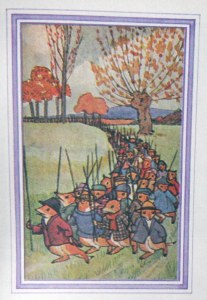
According to Contesting Home Defense: Men, Women, and the Home Guard in the Second World War, “The figure of Hare was an extreme expression of the view that Home Guards were not ‘proper soldiers’”. Not proper soldiers. Ouch! The book goes on to describe Home Guard exercises as “playing at war”, and likened to hanging out at the local water hole with the lads.


Uttley depicts Hare is a consummate cowardly-bungler, and getting in the way while all of the other animals, even Fuzzypeg and his cousins, do their parts with efficacy and courage. According to Contesting, the local defense headed by Moldy Warp “is well organized, uses improvised weapons to good effect, and fights bravely and well. Local defense is a serious and successful venture. Nevertheless the only animal labeled ‘Home Guard’ is the pompous, pathetic, and comical Hare.” Well, the world always needs laughter, and in this way I’d like to think Hare’s bungling in the book was a good distraction and measure of cheer for children during wartime. Also, I suspect Moldy Warp assigned him to the Home Guard to keep him from getting underfoot.
Stale bits…
Or rather the book is a product of its time and environment. Rabbit and Squirrel are given gendered roles; Rabbit is the Red Cross and Squirrel knits. However, their work is still very important and integral to the victory against the weasels. For example, Squirrel’s knitted socks and mitts allows for a silent sneak attack. Speckledy Hen sources and provides ammunition in the way of rotten eggs, but it’s left to Fuzzypeg and his cousins to use the weapons.


Stuff that a country child or a naturalist, or a farmer, or a historian of WWII might know…
Alderney Cow
Before receiving the news of the invaders. Rabbit is enjoying a pat of butter on her bread made from the milk of an Alderney cow. Uttley likely specified Alderney because it was part of the British Channel Isles evacuated after France fell in 1940 and later occupied by the Germans. Sadly, this breed of cattle is extinct.
Larch Tree
A type of pine tree used for turpentine, but Grey Rabbit uses the gum to make sticking plaster for bandages and casts.
Grey Rabbit mentioned in other books…
I read this book a few years ago before I ever laid hands on a copy of Hare Joins the Home Guard, just because it mentioned LGR. In Gone to Ground by British author John Harvey, a character is questioned about when she first suspected her deceased brother’s sexuality, and mentions Hare Joins the Home Guard.
And he used to read to me, when I was a lot younger. All those stories about Little Grey Rabbit and Squirrel and Hare, I remember.” Lesley was smiling, but there were tears running down her face. “Hare Joins the Home Guard, that was our favorite. Hare getting it all wrong and hurling his ham-and-egg sandwiches at this army of weasels because he doesn’t know what an ambush is.” She was crying loudly now, taking in great gulps of air.
Lesley and her Brother would’ve likely read the 1970’s reprint, or a Grandparent’s original copy. and were not directly touched by the horrors of WWII, but it’s the laughter and comical moments which the book provided that’s remembered and treasured, and I suppose may be the strongest point in Hare Joins the Home Guard. In any generation and world climate.
The Illustrations
Since it’s a LGR Library book, a picture on every page some of Margaret Tempest’s artwork is recycled from other books. For example, on page 11 a weasel isolated from the original background is shown holding a club and rope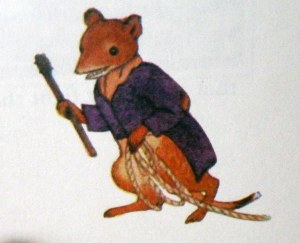
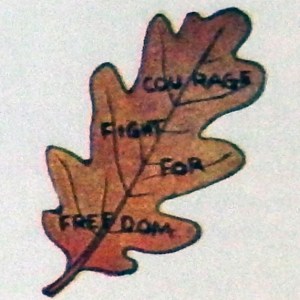
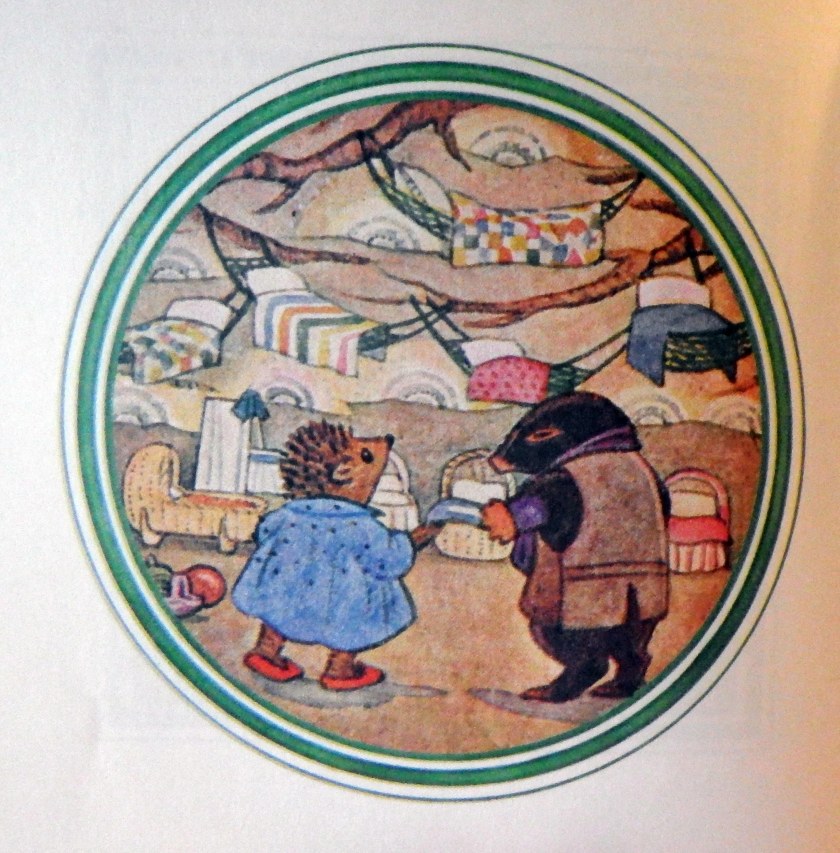
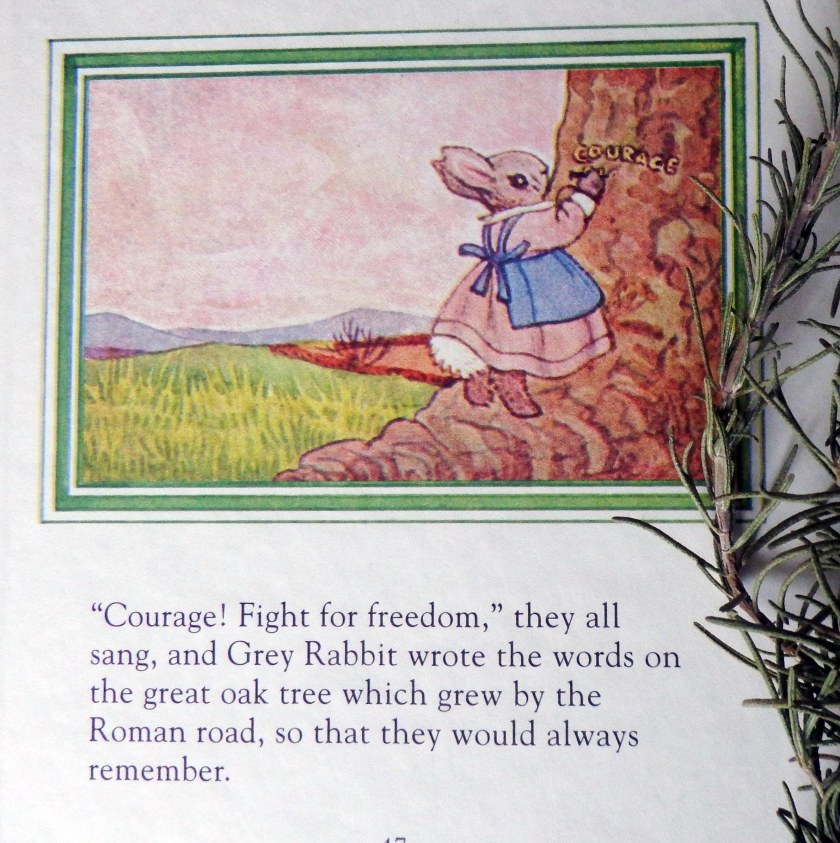
I believe it’s from The Hare, the Squirrel, and the Little Grey Rabbit. My favorites are Rabbit writing courage on the oak tree, Squirrel industriously knitting compliments the text very well. Another that stands out is the cavern dug by Moldy Warp to be used as an evacuation bunker for the children. It’s furnished by Grey Rabbit, illuminated by glowworms, and illustrated as very cozy and reassuring as a home nursery.


Final thoughts:
This is one LGR book we’re not likely to see as a reprint or in a treasury, although it’s seen several reprints since the original date of publication it looks like the 1994 abridgment was the last one. It’s not my favorite LGR book and if not for the 75thanniversary of D-Day I might’ve hung back on reviewing it. It falls into that realm of fantasy with animals behaving as humans to the point where the weasels live in their own lands. In Grey Rabbit’s land non-predatory animals coexists—with the exception of Wise Owl. Foxes are mention but not part of the Weasel invasion. Hare Joins the Home Guard refers to a very specific part of WWII and the study of social and local history on a micro level is as worthy as the large battles and famous personas. So, I’d still love to read the unabridged edition someday.

 Little Grey Rabbit Scholar