
Little Grey Rabbit’s Spring Cleaning Party


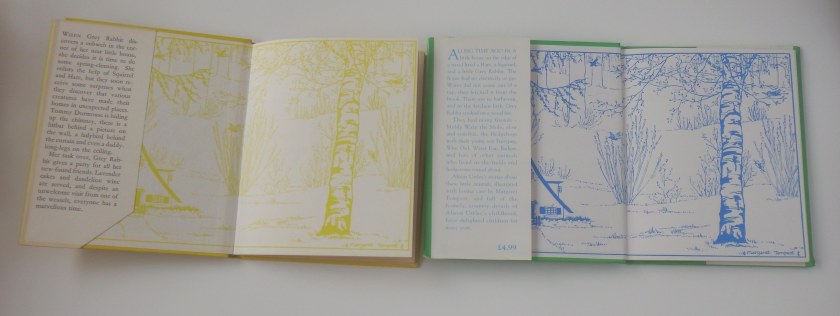
The foreword and Margaret Tempest’s endpaper design is included in both editions.
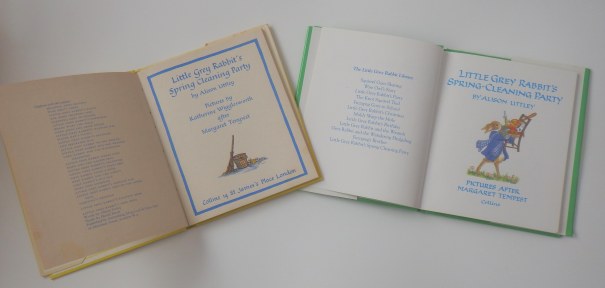
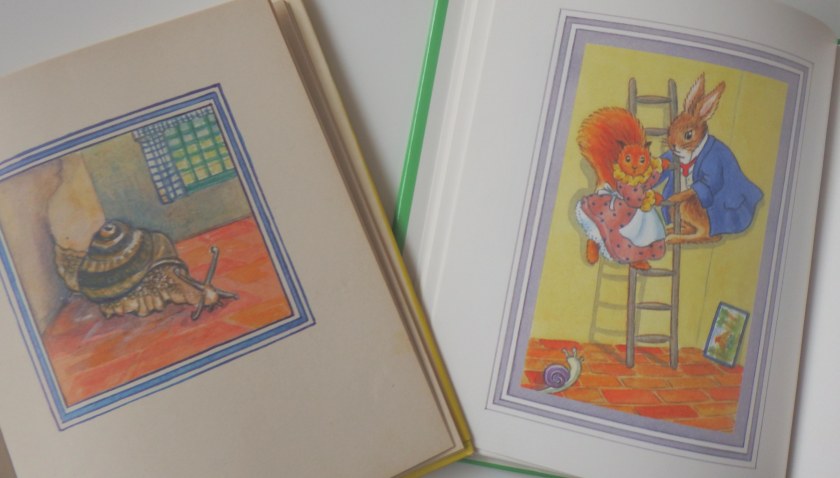
1971 pictures by Katherine Wigglesworth. (left)
1994 Reprint illustrated by Mary Cooper in the style of Margaret Tempest. (right)
The story takes places on a sunny spring day and the inciting incident is Grey Rabbit discovers a spider’s web in her house and decides it’s time for spring cleaning. As Rabbit, Hare and Squirrel clean their home they discover and shoo out a variety of small critters and insects that they refer to as their “lodgers”. As each lodger is discovered and kicked out of the house a relevant nursery rhyme, poem or folksong is woven into the text. Beatrix Potter used a similar device in The Tale of Mrs. Tittlemouse.
Grey Rabbit, softhearted dear, promises to give a party for all of the lodgers they kicked out. A weasel crashes the party in hopes of eating Rabbit and friends, but is thwarted by the small critters collective strength and a cunning trick played by Grey Rabbit. They party until sunset and everyone goes home.
Springtime just makes sense as a good time for cleaning a household especially pre-21stcentury. Country Living blogger Maria Carter cited some good reasons from an old Washington Post article on Spring Cleaning. The fireplace is being used less so the house is less sooty, the windows can be opened for a good airing of the house because you no longer have to conserve heat. Finally, more sunlight/daylight hours equals more energy. The story even starts out with Rabbit hiring Mr. Blackbird to sweep the chimney. According to this article, March was ideal to kick off spring cleaning because the high winds made airing out the Victorian house easier. In a world of roombas and gas fireplaces this book is a charming historical portrait of spring-cleaning.
All the lodgers (in order of appearance).
Spider and fly
Mary Howitt’s poem The Spider and the Fly
Little Tommy Dormouse
Nursery Rhyme: Little Tommy Tittlemouse, lived in a littlehouse
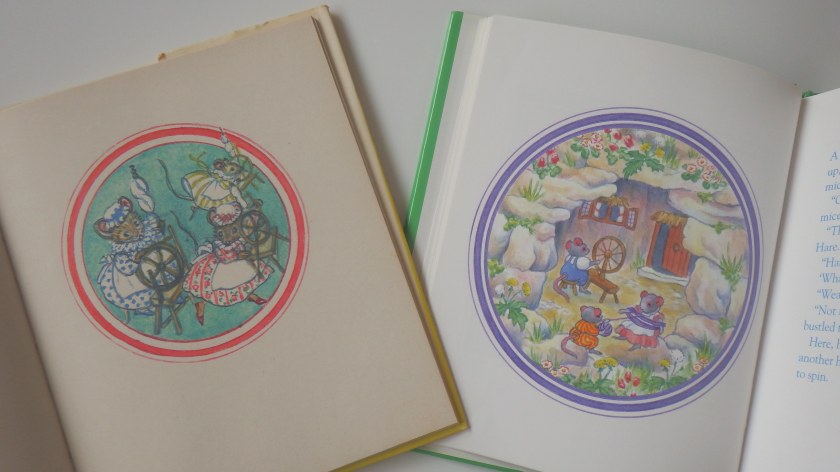
Three Mice
Nursery rhyme: Three little mice sat down to spin…
A Bat
Nursery rhyme: Bat Bat come under my hat
Ladybug
Nursery rhyme: Ladybird, Ladybird fly away home
Snail
Nursery rhyme: Four and twenty tailors went to kill a snail…
Daddy Long Legs
A rhyme made up by Alison Uttley, perhaps?
A Frog
English Folksong: Frog went-a-courtin
Weasel
Nursery rhyme: Four and twenty tailors went to kill a snail…
According to Grey Rabbit their lodgers were “spiders and flies, mice and a frog, daddy-long-legs and a ladybird, a dormouse and a Dumbledore”. It’s curious that the dumbledore (bee) is not illustrated or mentioned beyond this instance.
Some of the rhymes and songs that Alison used are lesser known, and others are very well know despite their age–I was surprised to find out Frog went-a-courtin’ dates back to the 16thcentury. It’s charming to see how Alison Uttley works them into the story, and yet that is where the editors decided to abridge the 1994 reprint edition. It doesn’t really shorten the story, but it also doesn’t harm it either.
“Not in my house!” this actually made me chuckle every time Grey Rabbit tossed out a lodger.
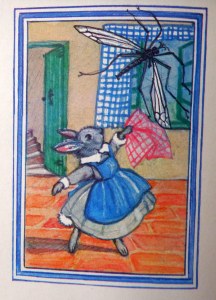
It struck me as though Alison was revealing a saucy side of Grey Rabbit even though she pities the ejected lodgers enough to throw a party for them. It’s rather like when you feel bad about squashing a bug or flushing one away.
A Brimstone is not a lodger, he is a welcome guest”, Hare explains to Fuzzypeg and Urchin when they come to help out with the cleaning. The brimstone, or butterfly is the only critter hanging out in the house that is not shooed away. He lives in the butterfly tree in the yard. Of course they would desire a useful insect like a butterfly to help out their garden.
Oppositely, In Mrs. Tittlemouse the butterfly is unwelcome and helping herself to sugar.
Both Rabbit and Mrs. Tittlemouse receive visits from ladies wearing spotted cloaks. I think this is a cute and engaging way to discuss the text with a little one. Not to mention a cute way to describe a ladybird. Alison Uttley did something similar in The Great Adventure of Hare. The fox is called a ‘red-coated gentleman’.
Overally, it contains a good collection of nursery rhymes and songs that I think would engage young readers—some they will recognize. Also, the moral of little critters coming together to defeat a larger foe is sound. There is a sense of community with all of the critters. Rabbit is firm but compassionate in the removal of lodgers, and I suppose you may interpret that as not punching down on the less fortunate.
Stuff you’d have to be a country child or a naturalist to know…
“..that is why I came to Grey Rabbit’s house, for I found crumbs here and sugar and rabbit bread…” Now, I’ve heard of Rabbit’s tobacco but Rabbit Bread was new to me. I went to Google after the encyclopedias turned up empty. It turns out Rabbit Bread is a very pretty yellow wildflower: Andryala Integrifolia. It’s found in Spain, and is an early spring flower according to this blog: Wildflowers of Andalusia It also seems to also grow in England too. I love this detail, every bit of the text is put there on purpose. Alison Uttley is not just adding fluff here and there.
The Illustrations
Little Grey Rabbit’s Spring Cleaning Party has the distinction of being illustrated twice; once by Katherine Wigglesworth and again by Mary Cooper. According to Dennis Judd, Little Grey Rabbit’s Spring-Cleaning Partyreceived positive reviews and part of that success was due to Katherine Wigglesworth illustrations—so it’s surprising that they’d feel the need to re-illustrate rather than pay Katherine Wigglesworth. Perhaps the original artwork was destroyed. Each lady is illustrating “after Margaret Tempest”, but only the 1994 reprint advertises it on the cover at the expense of the illustrator Mary Cooper. I suppose it was an appeal to parents and grandparents who mainly remember Margaret Tempest as the illustrator of LGR. Fear not, Mary Cooper is credited on the copyright information page. Both editions carry on with the colored borders of lines of varying thicknesses.
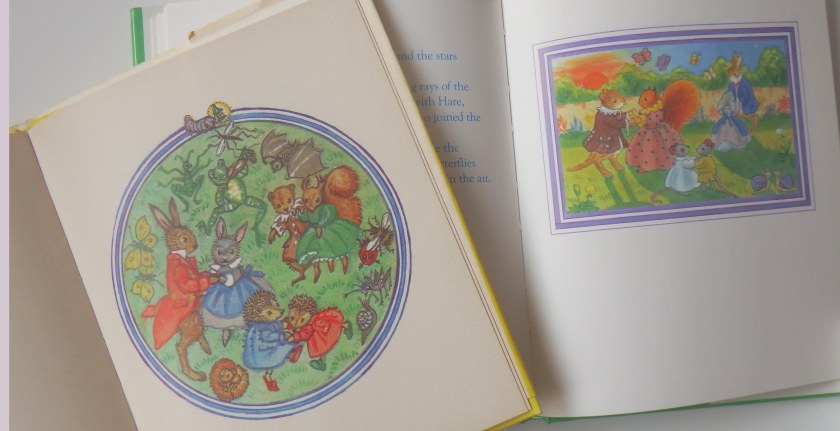
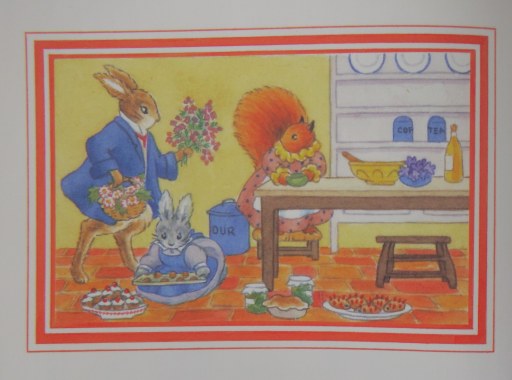
Cooper’s illustrations appeal to me more because they are a bit brighter and not too textured. The only one I didn’t like is the one where Hare appears to have puckered lips when shooing out Frog.
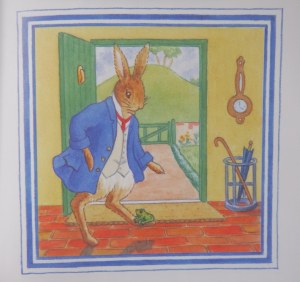
It is as though she crossed a line in the anthropomorphism by giving him lips, when all other images of Grey Rabbit and Hare is either side profile or showing the anchor shape mouth and nose.

My favorite Cooper illustration is LGR and friends up in the tree singing and playing instruments. Cooper’s weasel is a bit more menacing than Wigglesworth. He is very toothy and hungry looking. 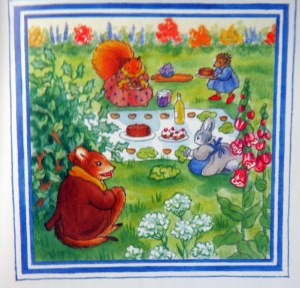
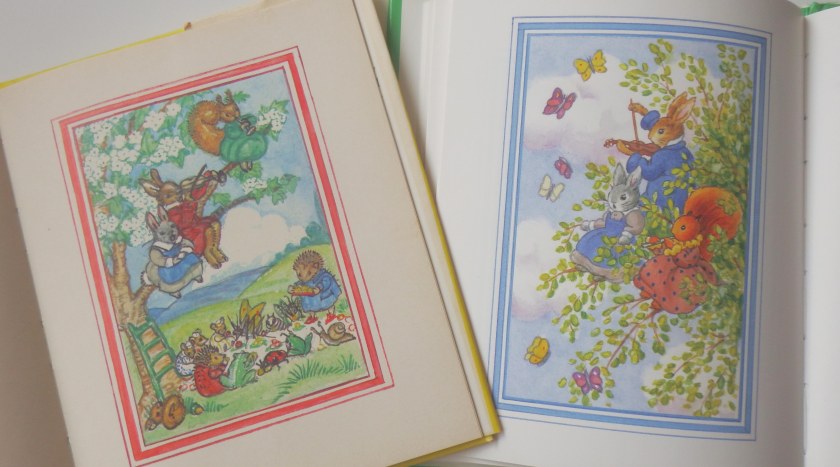
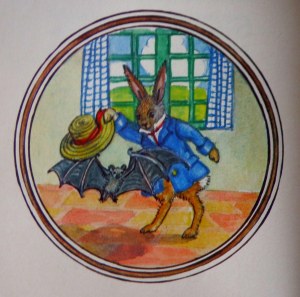
Anytime an animal is depicted with a frontal view of the face it falls flat. At times Wigglesworth does a weird halo of lines meant to show the fur texture and I don’t care for it. The colors in her illustrations are more subdued, but she includes lovely details like shadows, texture of floors. The scale of the snail is extremely exaggerated; he is as big as a Hare when in the house, but regular snail size at the party. Perhaps we’re getting Hare’s point of view of a larger than life snail? My favorite Wigglesworth illustration is Hare waving his straw hat over the bat. Wigglesworth conveys a good-natured smile on his face without giving him lips.
This was an enjoyable LGR book, I had never heard of Brimstones, Dumbledores, or Rabbit Bread. Not sure if that has to do with being American and suburban, but I enjoyed learning about them nonetheless.

 Little Grey Rabbit Scholar