
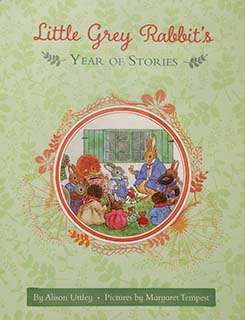
Little Grey Rabbit is the heroine of a collection of Animal genre-fantasy stories by Alison Uttley. The first book, The Hare, the Squirrel, and the Little Grey Rabbit was published in Great Britain in 1929 and first illustrated by Margaret Tempest. The books are slice of life type stories that usually deal with Grey Rabbit and her friends outwitting an enemy, celebrating a holiday, or enjoying an activity. Little Grey Rabbit’s Year of Stories is a hardcover book and it contains the following Little Grey Rabbit stories:
- Hare and the Easter Eggs
- Little Grey Rabbit’s May Day
- Little Grey Rabbit Goes to the Sea
- Water Rat’s Picnic
- Fuzzypeg goes to School
- Little Grey Rabbit’s Christmas
The six stories are organized seasonally beginning with spring and ending with winter. They are mainly holiday, vacation and life event stories.
The style is different compared to Little Grey Rabbit’s Treasury. Templar abandoned the scrapbook layout, omitted Alison Uttley’s foreword, the letter from the editor, although Susan Dickinson stayed on as an editor, the two page biographies of author and illustrator and quiz.
What it does have is a bookplate page, brief biographies of Uttley and Tempest’s on the rear dust jacket flap, a foreword by Denis Judd (Uttley’s authorized biographer), and a two page spread describing what the seasons are like for Grey Rabbit and her friends
Bookplate
It uses pretty vector art of green and yellow vines and dandelion heads encircling the “This book belongs to” part. The lines for writing the owner’s names are spacious.
Foreword
The foreword is entitled Little Grey Rabbit and Alison Uttley and is written by Professor Denis Judd—Alison Uttley’s authorized biographer and author of Futher Tales of Little Grey Rabbit. Judd sketches a background of Alison Uttley and the books that is informative in regard to Uttley’s breadth as a writer and the popularity of her work in her home country. Judd also references Uttley’s English country background, how she was a keen observer of the seasons. Her habits, superstitions, and traditions and how she consequentially worked them into her books out of fondness and partly for perserving traditions. Eighty-six years after Uttley’s original foreword, Judd’s foreword tidily expands on how much Uttley put herself and experiences into the stories. I still would’ve liked to see the original foreword included before the stories.
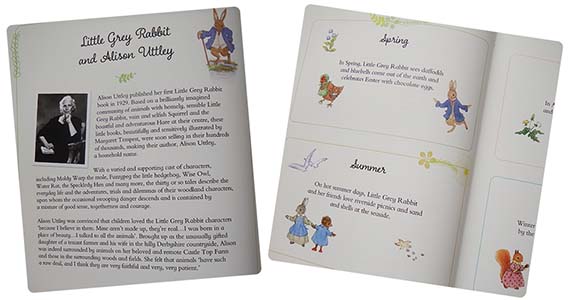
Organization
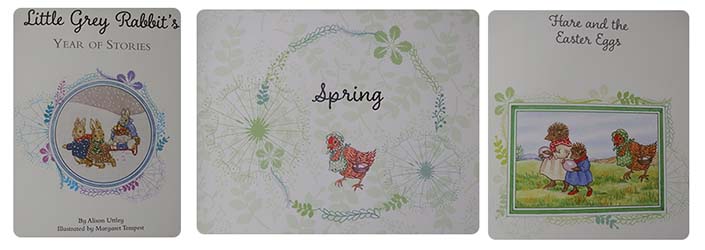
We see more of the vector art motif that was used for the bookplate. The stories are organized by their season and have a two page spread with a color palette appropriate to that season. For example, warm oranges and reds for autumn and cool blues and purples for winter. Each section has vector art encircled around an isolated character, for example spring shows Speckledy Hen. Vector art is also added to Tempest’s artworks that usually make up the title page.
Conclusion
It is still a good deal as far as getting multiple stories for the price of one used Little Grey Rabbit book, especially if you prefer clean new copies of books. If you already own the treasury, you’re going to end up with Grey Rabbit’s Christmas again. Another Little Grey Rabbit wintertime story could’ve been selected to avoid this repeat, for example Little Grey Rabbit goes to the North Pole or Little Grey Rabbit and the Snow Baby. However, Templar likely preferred a holiday story instead of a winter setting story.
Publisher: Templar Publishing, 2015. £12.99
ISBN 978-1-78370-261-9

 Little Grey Rabbit Scholar